| Home |
 |
|
|
 |
|
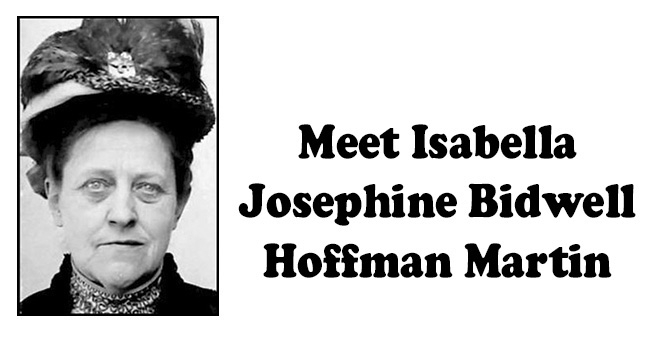
by JACK MAJOR In 1908, Oakland Police Chief Wilson was not alone in thinking Isabella Martin was a remarkable criminal, perhaps the most dangerous woman since Lucrezia Borgia. However, the "oohs" and "ahs" elicted from the public that year when Mrs. Martin went on trial for bombing the house of California Superior Court Judge Frank B. Ogden were more for her evil intentions than for crimes she'd actually committed. Oh, she'd been in trouble with the law for many years, but her offenses were annoying, not particularly serious. For the California press, she was an eccentric whose outrageous antics provided comic relief. That finally changed when it was discovered she was responsible for the bomb that destroyed the front of Judge Ogden's home in 1907. While the explosion was spectacular and windows were broken in several homes in the neighborhood, no one was injured. The person responsible remained unknown for almost a year, and, when Mrs. Martin was charged, it was revealed she'd made plans that, if successful, would have made her one of the history's most diabolical mass murderers. Fortunately for her intended victims, Mrs. Martin was the Wile E. Coyote of her time — clever at devising evil schemes, but inept at executing them, assigning that job to a teenage boy she once claimed was her son. Whatever threat Isabella Martin posed to the public ended with her arrest early in 1908, and the last 21 years of her life were spent in county jails, San Quentin prison and a mental hospital in Napa, California. She is little remembered today, and the two best online articles on the subject poke fun at her — "Meet Isabella J. Martin, the Crappiest Criminal in Bay Area History," by Rae Alexandra, and "Isabella J. Martin: The Queen of Grudges," by Paul Drexler. SHE EVENTUALLY compiled an enemies list, which puts in league with two U. S. presidents, but she had much more in common with Donald Trump than with Richard Nixon. Isabella Martin lied easily and often; when confronted with the truth, she held her ground or threw a tantrum. She initiated dozens of lawsuits, but seldom used the same lawyer twice because she didn't believe in paying her attorneys unless the result was exactly what she wanted, and it never was. In fact, Isabella Martin didn't like to pay for anything. And while the photo at the top of this page gives no indication, Mrs. Martin, in her early years, was considered unusually attractive, which is mentioned in several of the old newspaper stories I found about her. Before she was considered a criminal, she was usually described as an "adventuress," which at the time was a four-syllable synonym for "slut." After reviewing her misadventures through newspaper articles from the late 1880s through 1910, I've divided her life into four chapters — "The Adventuress," "The Forger," "The Actress," and "The Mad Bomber." The two fairly recent articles cited above are interesting, but both give the woman short shrift. She was a lot more interesting than they picture her. They ignore what I consider the most fascinating chapter in her life — her brazen attempt to launch a career as a stage actress during her chaotic stay in New York City in 1896 and 1897. She was to acting what Florence Foster Jenkins was to singing, and before she was laughed out of the Big Apple, Mrs. Martin made a name for herself in the city's newspapers, though usually for the wrong reasons. I'm surprised no one has made a movie about her, though her behavior often was so over-the-top that an accurate portrayal would likely seem too ridiculous to be true. This is particularly true about an 1894 court battle over a contested will that is covered in Part 2. The jury decided that the will in question was forged by Isabella Martin, but aside from losing the case, she was never punished for her creative penmanship. Instead, she became a celebrity of sorts in and around San Francisco. Birth of an adventuress . . . Her parents were Gilbert Bidwell and Asenath Cornelia Kingsbury, who married in Connecticut where their first child, Martha Layette Bidwell, was born in 1850. There's no truth to stories that claim Isabella was the sister of the notorious Bidwell brothers, George and Austin, who, in 1873, along with two accomplices, defrauded the Bank of England of more than £500,000, using forged letters of credit. Since Isabella occasionally forged documents, there was speculation of a family connection. While she did hint a few times that she was related to the Bidwell brothers, she ultimately denied it. (I found enough information about George and Austin Bidwell to know Isabella Bidwell was not their sister, nor was she a daughter, niece or first cousin.) Gilbert Bidwell and his wife, who apparently went by her middle name, eventually settled in Elmira, New York, where Isabella grew up and where, in 1863, her younger sister, Fannie, was born. Meanwhile, Isabella became better known in Elmira as "Belle" and soon was regarded as the prettiest girl in town. BELLE BIDWELL graduated in 1872 from Elmira Free Academy, the local high school. During the graduation ceremony, according to the Elmira Advertiser (June 27, 1872), "Miss Belle Bidwell, who excels as a recitationist, read in a capital manner her essay, 'We Build Our Own Monuments.' There were many beautiful ideas in this production and all expressed in fine style." When Isabella Bidwell Hoffman Martin came to trial many years later, the Oakland Tribune had this to say about her life in Elmira: |
|
|
|
Jacob Lowman was perhaps the best-known farmer in that part of New York. Cheating him was a big, big mistake. And if either approximate date is correct, Gilbert Bidwell deserted his family while his middle daughter, Belle, was in high school. It must have been difficult for the Bidwell family to carry on, yet the above article goes on to say the young woman "always managed to dress rather stylishly. In fact, she was a woman to whom any clothes were becoming." Some folks in Elmira thought Belle Bidwell's future would find her on stage, but a year after high school graduation, on September 9, 1873, she married Jacob Bowman Hoffman. Both were 21. The Hoffman family was well known and respected and well off financially. Reportedly, Jacob's parents tried to talk him out of the marriage, which ended in divorce 10 years later. This is how news of the divorce was received in Syracuse where Isabella and Joseph B. Hoffman lived during the last two years of their marriage: |
|
|
|
IT'S DOUBTFUL she made the move for health reasons. Yes, throughout her life, Isabella Bidwell Hoffman Martin had a series of illnesses, but they were always short and more convenient than serious. As for Jacob B. Hoffman, I found an ad in the Elmira Daily Advertiser (December 24, 1880) that indicated he was a dealer in coal, wood, lime, cement, land plaster, lath and brick. However, three months later, Hoffman and Henry C. Green went into partnership in a seed and florist shop. And, in 1882, according to the Syracuse Herald, Hoffman took a job as auditor for the West Shore Railroad. Other stories describe him as a civil engineer and a railroad surveyor. During his second marriage, he turned to farming and settled in Oakley, Michigan, where he became one of the area's most prominent citizens. Some old newspaper articles say Hoffman's work, whatever it was during his marriage, often took him out of town, which did not please his wife. Some articles say she, too, occasionally went out of town by herself. Along those lines, I found this interesting item: |
|
|
|
I also found three mentions in the Elmira Daily Advertiser of Belle Hoffman performing during her marriage — twice as a recitationist, once as an actress in a play. She earned rave reviews for all three performances. This is what the Elmira Daily Advertiser had to say about her performance at the First Methodist Church social in September, 1882: |
|
|
|
| That may be the event referred to in the following story written many years later when Isabella Martin was awaiting trial for bombing Judge Ogden's house: | |
|
|
Apparently, Isabella Bidwell Hoffman was amply endowed and, like Jayne Mansfield many years later, was not bashful about exposing a lot of cleavage. ISABELLA gave birth to her daughter, Sarah ("Sadie") eight months and three weeks after her wedding, and two years later would have a son, Henry. Otherwise, the marriage of Isabella and Jacob Hoffman must have been unusual for the era. Mrs. Hoffman was not a faithful wife and the couple divorced shortly after their 10th anniversary. Her whereabouts during the next five years are a bit of a mystery. She moved around a lot, and reportedly spent time in New York City, Philadelphia and California. For sure she was in San Francisco for awhile, then back in Philadelphia briefly, but by late 1887 was out west again, this time in a remote part of California where she met the man who would be her second husband, John W. Martin, who was 26 years her senior. An article in the San Francisco Examiner has her meeting Martin while she was still legally married to Hoffman, but that isn't true. Shortly after her divorce, she did have an affair with a California man, but it wasn't Martin. More on that in Part 2 of this story. She once told an Associated Press reporter: "The general public have an erroneous idea about my meeting with John Martin. I was on my way out here (California) to visit my uncle, my mother's eldest brother, when I met John Martin. I was on my way to Hayfork in Trinity County, when I met John Martin on the cars. He left my party at Red Bluff, but gave me a letter to his brother, Henry, whom he said I should meet at Weaverville." By "the cars," I believe she was referring to a train that stopped at Red Bluff on the way from San Francisco to Redding, where Isabella would get off to board a stagecoach that would take her to Hayfork, not far from Weaverville in a rugged, remote part of California known as the Trinity Alps Wilderness Area. This is more than 200 miles northwest of Sutter's Mill, where a discovery of gold kicked off the great California gold rush of 1849, but it was near Weaverville where the Martin brothers looked for gold and found enough of it embedded in quartz to finance other businesses. John Martin spent most of his time in Weaverville, but owned property in San Francisco and Oakland, 260 miles away. Henry eventually made his home at San Francisco's Palace Hotel. AS MYSTERIOUS as Isabella's whereabouts for those five years is her relationship with her children. Reportedly, she was awarded custody, but daughter Sadie spent most of her growing-up years in Elmira, living with her grandparents, Mr. and Mrs. George Hoffman. Son Henry eventually lived with Isabella in California, but it looks as though he was bounced around a lot from the time he was seven until he was 12 and his mother was remarried. My guess is Mrs. Hoffman's meeting with John Martin took place in 1886 or 1887, by which time John would have celebrated his 60th birthday and Henry his 50th. Both men were bachelors. John Martin left Maine for California in 1849 and mined for gold with enough success to open a livery stable business and a general store in Weaverville where the store's most important items were grain and flour. His brother, Henry, ten years younger, followed John to California and worked for him at the store until he made an investment that turned him into the area's richest man. He partnered with two other men and bought the Brown Bear gold mine 30 miles east of Weaverville. The trio had a hunch the mine wasn't played out. Their hunch paid off, but Henry Martin's wealth was greatly exaggerated by newspapers. Isabella claimed she could have married Henry, but chose John. On January 8, 1888, they wed; she was 35, he was 61. (Two years later, Henry, at age 54, would marry a rich widow, 42-year-old Mary "May" Blunt, whose first husband was a long-time friend of Henry.) WHEN NEWS of Belle Bidwell's second marriage reached Elmira, it inspired the following story which suggests her first marriage and her divorce were the talk of the town a few years earlier. Of all the old newspaper articles I've found about Isabella Bidwell Hoffman Martin, this short item is the most interesting, perceptive and prophetic. The anonymous writer obviously knew things about the woman that must have been common knowledge in Elmira, but weren't fit for publication in the local nespaper. |
|
|
|
This anonymous reporter certainly had the woman pegged. What struck me most was the reference to "some trouble" Isabella Hoffman had encountered in one of the western states. That trouble was her affair with a married San Francisco businessman in 1885. When that was mentioned in the infamous will trial in 1894, it seemed to surprise many people, yet a reporter 3,000 miles away in Elmira knew all about it nine years earlier. The only thing the Elmira reporter got wrong in the above story is the esimate of John Martin's wealth. He was not worth $6 million, not even $1 million, but closer to $100,000, which still made him the wealthiest man in tiny Weaverville — at least before his wife began draining him. Henry Martin. no longer a resident of the Weaverville area, would tell anyone who'd listen that his brother, John, was miserable during this marriage to Isabella, and that he was contemplating a divorce. Isabella must have known her lavish spending and frequent trips without her husband had put her marriage in danger, so in 1891 she did something strange and suspicious — she went by herself to New York City, and when she returned, she had with her an infant son, claiming she had given birth in a Manhattan hotel. She named the boy John Bidwell Martin and insisted her husband was the father. Whether John Martin believed his wife, no one ever knew for sure. However, brother Henry made it clear he did not believe it. Not only was Henry convinced his brother didn't father the child, he was certain Isabella wasn't the child's mother. Henry believed Isabella had bought the child from a home for foundlings. Henry told his wife that John was going to make out a will that excluded both his wife and the child who became known as "Baby John," a tag he'd never be able to shed. WHETHER John Martin ever made out a new will was a question never answered. If he had, it disappeared. On July 30, 1892, John Martin died, much to the shock and surprise of Henry, who suspected his brother was poisoned by Isabella. Henry shared his suspicions with his wife, but made no public accusation and Isabella gained possession of her husband's estate, worth about $40,000, with some rental properties in Oakland. There was no reason to think Henry Martin and his wife wouldn't be around for many more years, but just after Christmas, 1892, May Martin fell seriously ill and wasn't expected to live. She remained in critical condition for many weeks. Then, in late February, 1893, Henry also became ill and died a few days later. |
|
|
|
Miraculously, May Martin survived, and when she was completely recovered, well, that's when all hell broke loose. |
|
| Part two: The Martin will case |
| HOME | CONTACT |