| HOME • FAMILY • YESTERDAY • SOLVAY • STARSTRUCK • MIXED BAG |
 |
 |
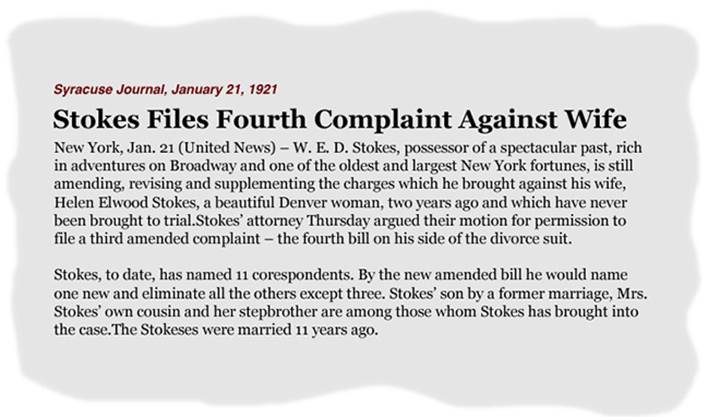 |
Many consider this the dirtiest divorce of its time, perhaps of all time. That a man would name his son as corespondent is what attracted my attention to the case. What held my attention was the depth to which William Earl Dodge Stokes Sr. sank in his efforts to have his wife declared an adulteress unfit to be given custody of the couple's two children. Though she had much more evidence on her side, had she chosen to smear her husband, Mrs. Stokes held the high ground throughout an incredibly long case that — like a car spinning its wheels in the mud — made a lot of noise and splattered a lot of people, but wound up where is started. Stokes' lawyers should have been delighted at the prospect of a big pay day, but some of them had to take him to court to collect what he owed them. They were lucky to get 75 cents for each dollar. As for Helen Ellwood Stokes, she must have been transformed during the eight years she and her husband lived together, because it hardly seems possible that the woman who gave better than she got during cross-examination by one of the country's best lawyers could be the same person foolish — or greedy — enough to marry W. E. D. Stokes, a strange, suspicious man who preferred to communicate through subpoenas. The arrogant Stokes had a knack for making enemies. His wealth made him distrust most people, especially lawyers, though he constantly summoned them to handle his many lawsuits. (At least once he tried handling a case by himself, but fared poorly.) He was often foolish, but led a fascinating life, though it ended, I think, well short of expectations. He died with less money than he had inherited, and his money continued to trickle away after his death, due to lawsuits initiated beforehand, or later filed against his estate. What follows is a long tale. That 1921 newspaper item at the top of this page was a starting point, but the Stokes story soon sent me back to the 1800s. His divorce suits against Helen Ellwood Stokes in 1921 and 1923 captured the attention of millions of newspaper readers, but it was a sad and shameful waste of money and time. That also could be said about the often bizarre life of W. E. D. Stokes, who met a lot of prominent people – and managed to infuriate most of them. I found no explanation, but throughout his life he will almost always be referred to by his initials rather than by his first name. Here's a hop, skip and a jump through the years leading up to his marriage to Helen Ellwood, his second wife. In truth, Stokes never got over wife number one, who was a teenager when she married him. But she dumped him five years after they were wed. |
| 1852: William Earl Dodge Stokes is born into a wealthy New York City family. His parents: James Boulter Stokes and Caroline Phelps Stokes. W. E. D. is the youngest of four sons. His brothers are Anson Phelps Stokes, James Boulter Stokes Jr. and Thomas. He has four sisters, Elizabeth, Dora Lamb, Olivia and Caroline. |
| 1873: W. E. D. Stokes' first cousin, Edward S. "Ned" Stokes, is convicted of murdering prominent financier Jim Fisk, and sentenced to hang. He wins a retrial and again is found guilty. There is yet a third trial, this one paid for by his uncle James Stokes at the urging of his son, W. E. D., then just 21. The third trial results in another guilty verdict, but a much softer sentence. A few years later, the Stokes cousins become business associates – and bitter enemies. For several years, Stokes vs. Stokes will refer to legal battles between "Ned" Stokes and W. E. D. |
| 1889-1890: W. E. D. Stokes is appointed as secretary on a committee formed to secure the 1893 World's Fair for New York City. Committee chairman is former mayor Abram Hewitt, who develops an intense dislike of Stokes. The feeling is mutal. Stokes resigns the committee and the World's Fair is given to Chicago. |
| 1895: Nineteen-year-old Rita Hernandez y de Alba de Acosta becomes the first Mrs. W. E. D. Stokes. She undoubtedly is the love of his life, but the love of her life is ... shoes. It's no surprise their marriage is brief, ending several months before divorce makes it official in 1900. She gives birth to William Earl Dodge Stokes Jr. a year after the wedding. Although the boy is placed in her custody by the divorce, she sends him to live with his father. She'll spend the rest of her life denying that she sold the boy to Stokes. |
| 1896: W. E. D. Stokes purchases the Patchen-Wilkes horse farm near Lexington, Kentucky. He may have had a love of horses beforehand, but the timing indicates the property was acquired to please and impress Mrs. Stokes, a world-class rider. During the next three years the farm often is referred to as belonging to her, though it remains Stokes property for several years after the couple is divorced. Several leading trotters are bred at Patchen-Wilkes. It was probably love or perhaps the fact that he was younger at the time, but Stokes tries much harder to impress wife number one than he will wife number two. |
| 1902: While taking a ride in his carriage, born-again, 50-year-old bachelor W. E. D. Stokes is flagged down by a pretty young woman who's leaning out her bedroom window. Her name is Lucy Ryley (she later takes the last name Randolph). Thus begins a sad, tawdry affair. In 1907 she sues Stokes for child support, claiming he is the father of her four-year-old son. Stokes, a veteran of more court battles than he can count, wins this one on a legal technicality. What happens afterward to the woman and her son is unknown. |
| 1899-1904: Stokes commissions an architect to design an apartment hotel, then supervises its construction, doing whatever it takes to have it built on schedule. At this he fails. Miserably. Construction is delayed many times, and the hotel is finished 18 months later than planned, and Stokes goes about $1 million over budget. A New York Herald story (May 18, 1903) blames the delays and the cost on Stokes' ignorance of — and stubborness toward — labor unions. He insisted on hiring all the workers himself. He names it the Hotel Ansonia after his maternal grandfather, Anson Greene Phelps, who founded a Connecticut town by the same name. When it opens, the Ansonia is the biggest, fanciest hotel in New York City, the first to be air conditioned. |
| 1906: John Singleton, millionaire and partner in the gold-rich Yellow Aster mine in California, checks into the Hotel Ansonia with his wife, Stella Graham Singleton. They are joined by Mrs. Singleton's sister, Lillian, an eighteen-year-old would-be actress. W. E. D. Stokes wastes no time introducing himself to the teenager. It's the beginning of an affair that leads to the wildest night of Stokes' life. (See 1911, June 7, below) |
| 1906: In October, an ex-convict named Al Adams, the one-time king of the New York City numbers racket, commits suicide in his suite at the Ansonia. City coroner Julius Harburger, who'll later be elected sheriff of New York County, thinks Adams was murdered, and sets out — in vain — to prove the crime was committed by W. E. D. Stokes. |
| 1907: The Ansonia may be fancy, but what's that smell coming from the roof? Why, it's the Stokes farm, that includes several animals, including enough chickens to supply hotel tenants with eggs. The city takes steps to eliminate the farm, which violates a city ordinance, and after one false start finally succeeds. Years later, Stokes will buy more chickens and keep them in his apartment, much to the displeasure of the second Mrs. Stokes. |
| 1910: Lovely Helen Ellwood of Denver, Colorado, moves into the Hotel Ansonia as the guest of Dr. and Mrs. Wilbur A. Hendryx. W. E. D. Stokes soon notices the new tenant and comes a'courtin'. |
| 1911: February 11: W. E. D. Stokes and Helen Ellwood are married in Jersey City, N.J., by a college classmate of Stokes, who lies about his age and why they "had to" get married secretly. |
| 1911: June 7: During a visit to his old girl friend Lillian Graham, supposedly to retrieve some letters, Stokes is shot three times in the legs and beaten by three Japanese men who were setting up a dinner party across the hall. Thus begins The Case of the Shooting Show Girls. |
| 1914: In September Mrs. Helen Stokes gives birth to her son, James, in Denver, where her mother lives. |
| 1915: December 29: Mrs. Stokes gives birth to daughter Muriel at the Vanderbilt Hotel in New York City. |
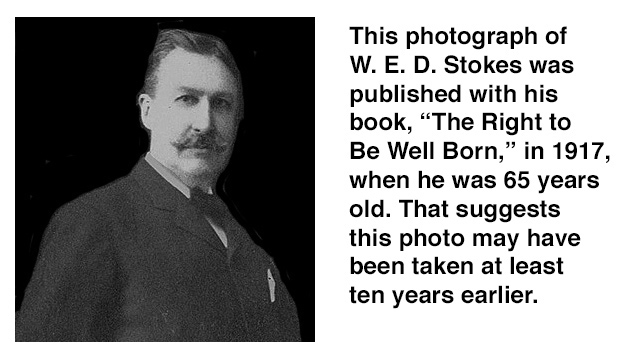
| 1916: W. E. D. Stokes holes up at his Kentucky horse farm and writes a book – “The Right to be Well Born: Horse Breeding in its Relation to Eugenics.” In it, he suggests the solution to many of our problems is good breeding. He endorses the idea of sterilizing defective humans. He obviously believes in a caste system. Few people read the book. It would have been better for the his legacy — such as it is — if the book had been destroyed because "The Right to be Well Born" placed Stokes alongside Adolf Hitler; they had similar views on a master race. |
 |
| 1917: November 4: Jewels valued at many thousands of dollars belonging to Mrs. W. E. D. Stokes are stolen from a locked suitcase while she travels from Denver to New York by train. Mrs. Stokes tells the police the gems were in a brown covered case. She suggests the thief possessed a key. The implication is not lost on her husband who, some believe, arranged the theft in hopes of discovering some of the jewelry had been given to her by another man. The jewels and the theft become issues in the divorce case. |
| 1918: Mrs. Stokes finally has her way about leaving the Hotel Ansonia, which she feels is not a proper place to raise children. The family moves into a house a few blocks away. |
| 1918: December 31: Mrs. Stokes goes out for the evening with her visiting second cousin, Hal Billig, her husband begging off on account of illness. Mrs. Stokes and Billig return later than Stokes thinks appropriate. Long-held feelings of jealousy and resentment spill out in a three-way argument that, in effect, ends the marriage. Billig checks into a hotel that evening, Stokes moves back to the Hotel Ansonia – by himself. |
| Divorce was inevitable. W. E. D. Stokes plots his case for more than two years before taking it to court. Mrs. Stokes has another agenda, choosing to remain his wife while living 2,000 miles away, in Denver, until she recovers dower rights she signed away in the early months of her marriage. Stokes will wish he had never messed with the former Helen Ellwood, who also will be more than a match for his lawyers, even highly regarded Max D. Steuer, one of New York's best. |
| Stokes vs. Stokes begins |
| HOME | CONTACT |