| HOME • FAMILY • YESTERDAY • SOLVAY • STARSTRUCK • MIXED BAG |
 |
Old photos are like time machines I used to call the occasion Ohio's first Take Your Infant To Work Day, my solution when my then-wife, Karla, had a 10 a.m. dentist's appointment and we had no one to care for son Jeffrey, then just a few months old. So I took him to work – or wore him to work, as the case may be – in a back carrier that was a fairly new idea at the time. Babies placed in these things generally seemed comfortable and at ease. So it was with Jeff who probably was bewildered the four hours he was with me, but remained quiet and responded well to the several people who greeted him. Co-workers, especially those of the female persuasion, thought this was a terrific thing for a father to do, though there was some concern over how much an infant would disrupt my work. Because of the routine on this particular day, there was no disruption. If anything, it was like I had a silent (therefore pleasant) supervisor looking over my shoulder the whole time.
AT THE TIME I was a feature writer and editor of the newspaper's TV magazine. What I'm doing in the photo is proofreading pages, checking for typos. I'm doing this in what was called the composing room where linotype machines were used to create – you guessed it – lines of metal type; compositors then placed the lines of type into page forms. Usually stories ran long or came up short. (Oldtimers may remember those little fillers that were common in newspapers, tidbits used to fill holes at the bottom of a column; i.e. "The hummingbird is the only bird that can fly backwards" or "Cattle branding was practiced 4,000 years ago. Old tomb paintings show Egyptians branding their fat, spotted cattle.") Stories that ran long? Well, that could be a problem, especially with certain writers. Let me digress for one of my favorite newspaper stories: The late Dick Shippy was an Akron colleague and the closest thing I ever had to a mentor. Before I joined the paper he worked in the sports department. One Saturday night it was his job to check the pages in the composing room. Our most notorious sports writer (who shall remain nameless) had turned in a story about the day's Ohio State football game that was about 25 inches too long for the space that had been allotted by the sports copy desk. Shippy carried the message to the writer, who wasn't pleased. He suggested there must be some way to squeeze the whole story into the paper. Shippy said it couldn't be done. In those days reporters and editors had jars of rubber cement on their desks; we'd paste pages together before the stories were sent to the composing room. Some writers didn't like rubber cement; they took long rolls of paper from wire service printers and ran them through their typewriters. Anyway, Shippy held out the long paper version of the story and let it flow across the floor like a bridal train. "You've got to take 25 inches out of this story," he repeated. Still the writer wouldn't budge. Another common tool in those days was scissors. So Shippy picked up some scissors, cut the story in half and took the half he was holding back to the composing room. Unfortunately for Shippy, this sealed his fate in the sports department; he didn't have as much clout as the writer he had challenged. Shippy was reassigned to the features department where he became a TV columnist with the newspaper's largest readership. Sweet revenge, perhaps. Okay, so now ... SKIP AHEAD 20 years. I've relocated – twice – leaving Ohio to work a year in Pittsburgh, then finding what would prove to be my life's work in Rhode Island at the Providence Journal. Linotype machines have become a thing of the past. The Journal has restored one and turned it into a sculpture-like exhibit in the new composing room which is about one-fourth the size of the old. Metal – or hot – type has been replaced by computer-generated "cold" type on slick paper that is waxed, then put down on heavy paper forms. Gone are the good ol' days when someone would accidentally spill lines of type all over the place. (I believe "pi the type" was how such accidents were described.) For a while after "cold" type arrived, a certain carelessness was apparent in newspapers. In the days of hot type, the excess – or overset – was put aside. With cold type, however, it often was placed on the pages in advertising space, the idea being it would be dealt with after the page was proofread. There'd be some cutting and re-pasting until the story fit, and the excess discarded in a waste basket. But sometimes that overset was neglected and left where it didn't belong, which a day later confused readers and upset advertisers. That period didn't last long because it soon became apparent to make up whole pages in the newsroom, correct mistakes, and re-do the whole page. There was no more composing room. BECAUSE of such changes, I look at the above photograph a different way. My eyes no longer focus on my son, but on the metal frames and the rolling tables that once made the composing room a life-sized, ever-changing maze. No lie – I still have a dream now and then in which I am trying to negotiate my way from deep in the composing room back to my office, only to find my path blocked at every turn by a wall of heavy, rolling tables, men yelling at me not to touch those tables. Not that I ever consciously miss the old composing room. The newspaper environment in the 1980s was cleaner and more comfortable, but, yes, when in a nostalgic mood, I feel something is missing. This photograph has become a reminder what that something is. I wish Ted Walls had included a Beacon-Journal compositor in the photo, especially one who wore a hat fashioned from the day's newspaper, one of the things that gave composing rooms the look and feel of a factory. In 1988, the photograph stirred up many memories, and while a few are sad (especially reminders of people who are gone forever), most are humorous, reflecting on a time that seemed quaint and unchanged from the 1920s. But to a lot of people my age, the 1970s and '80s were the best years to be employed by a newspaper, especially when that newspaper seemed to have a lock on its market the way the Providence Journal did. NOW WHEN when I look at the photograph, I'm no longer laughing. Newspaper are in deep, deep trouble. Few people subscribe to the print versions, and, frankly, their internet versions, for the most part, are embarrassing. They ask us to support journalism — a worthy cause, to be sure — but their home pages, which you can consider the electronic eqivalent of print journalism's front page, are a hodge-podge designed to catch everyone with some item. Headlines for some stories can be found two or three times as you scan the pages; some headlines linger for days. News stories mingle with promotions for the latest Ask Amy column, not to be confused with an ad for Suze Orman's latest advice on how to invest our money. Ah, the ads. Today I saw such things as:
Those ads or come-ons exist on newspaper websites because they help pay the bills, and they will remain unchanged for weeks on end. Click on them at your peril, especially, I suspect, the one about 15 states, because that's surely one of those things that has you clicking and clicking and clicking to see the whole list, which is bogus, anyway. And I love that the one about toe fungus ends with "tonight." It would have been much catchier to say "a week from next Tuesday." I haven't the patience to provide a complete explanation that you wouldn't have the patience to read, but I believe newspapers sealed their doom when they hired designers to plan their front pages. The problem is obvious today on their websites, which wouldn't be such a mess if they were done by hard-nose journalists, who'd know enough to keep them simpler, and maintain separate home pages for sports, lifestyle and business. If you want us to subscribe to a newspaper online, give us an online newspaper, not something that looks like an IHOP menu. |
|
| HOME • CONTACT |
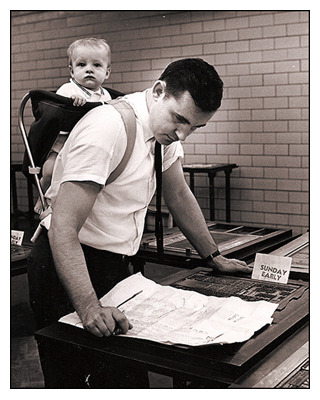 This photo appeared in the paper the next day and later showed up in other publications, including Editor and Publisher. A few people called me "Mr. Mom," and this was before there was a movie by that title.